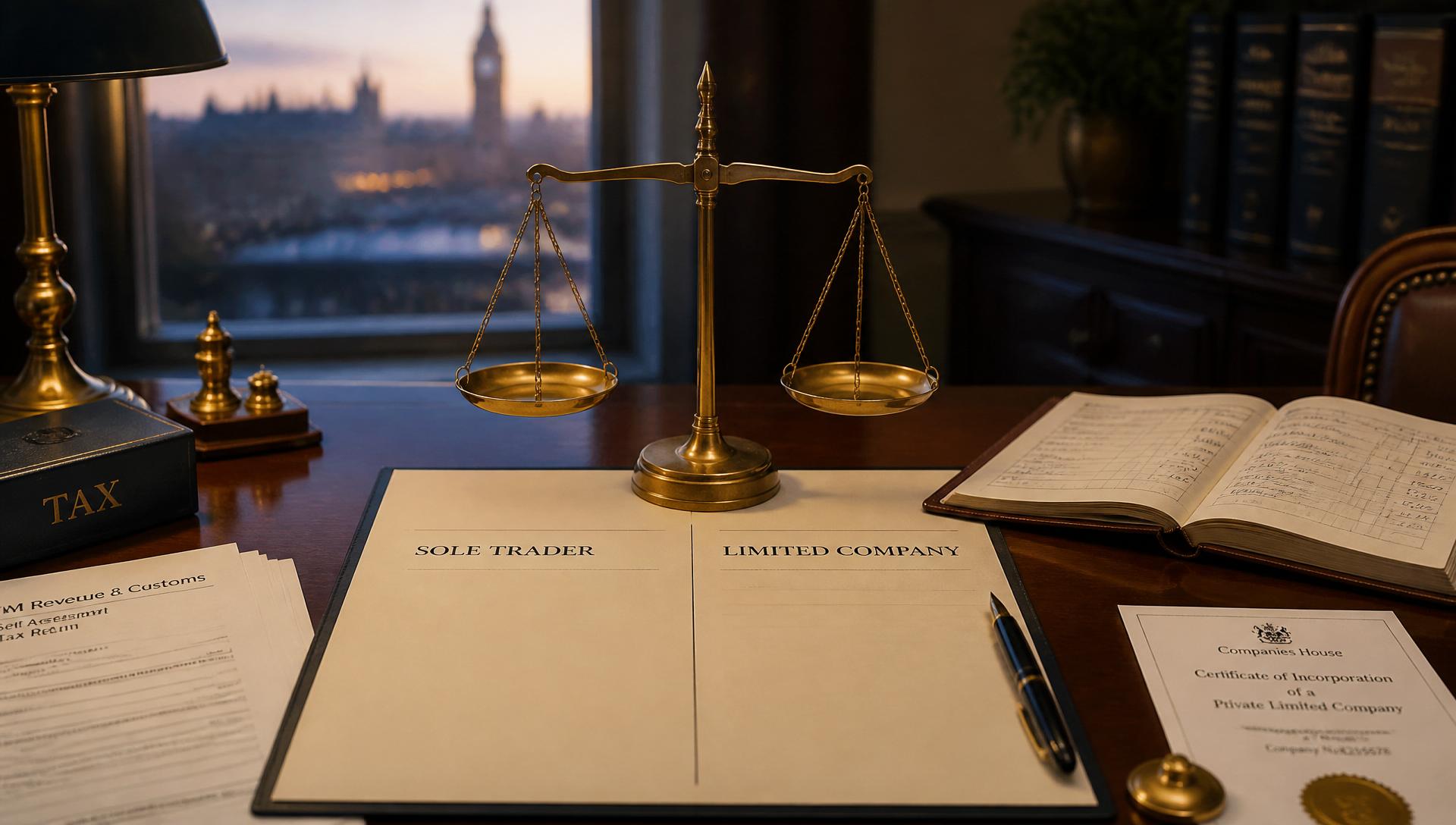
Sole trader vs Limited Company — the decision UK founders keep getting wrong.
A senior-advisor comparison with the real 2026 numbers, the liability rules that actually apply, and the six trigger points that turn a maybe into an obvious yes. No templates, no motivational content — just the conversation we have with founders before they choose a structure.
The sole trader versus Limited Company question is almost never really a tax question. It is a question about who buys from you, how much of what you earn you actually spend, whether the business needs to outlive its founder, and whether the people you want to trade with will accept an individual on the other side of the contract. Tax matters — and below we run the exact 2026 numbers at three profit levels — but the founders who make the wrong choice almost always make it because they optimised the tax and ignored the structure. This guide is the full conversation. If after reading it the answer is still unclear, book a call — the numbers are worth an hour of careful thinking.
- Below ~£30,000 profit sole trader usually wins on total cost after compliance.
- Between £40,000 and £100,000 a Limited Company typically saves £1,500–£6,000 a year with disciplined drawdown.
- Above £100,000 the sole trader 60% marginal rate makes incorporation almost mandatory.
- Limited liability is real but not absolute — personal guarantees, wrongful trading and PAYE/VAT liabilities pierce the veil.
- Sole traders cannot issue shares — SEIS, EIS and any priced investment require a Limited Company.
- Employer pension contributions from pre-tax profit are the single most under-used advantage of incorporation.
- Non-residents should almost always incorporate; UK banks rarely accept non-resident sole traders.
The decision in one page
Three variables settle roughly 90% of cases. First, annual profit — the delta between sole trader and Limited Company is small below £30,000, meaningful between £40,000 and £100,000, and decisive above £100,000 because the personal allowance taper creates a 60% marginal rate. Second, spending pattern — a founder who spends everything they earn loses much of the company advantage because dividend tax reduces the gap, while a founder who retains 20–40% inside the business defers personal tax indefinitely at 19–25% Corporation Tax. Third, who you sell to — B2B, enterprise, international and investor-facing businesses are structurally biased toward Limited Companies; UK consumer trades are structurally neutral.
Everything else — liability, credibility, pension planning, spouse share splits, SEIS, banking, name protection — stacks on top of those three answers. When two or three of them point the same direction, the choice is obvious. When they conflict, run the numbers with an advisor before anything else.
Rule of thumb: if profit is sustainably above £40,000 and at least one of (B2B customers, employees, investors, non-UK residence) applies — incorporate. If neither applies — stay a sole trader and revisit next year.
What being a sole trader really means in 2026
A sole trader is not a legal entity. It is HMRC's administrative label for a self-employed individual carrying on a trade. There is no separation between the person and the business — the contracts are yours, the bank account is yours, the debts are yours, the intellectual property is yours, the tax is yours. You register for Self Assessment within three months of starting to trade, submit one return each January covering the tax year to 5 April, and pay income tax and Class 4 National Insurance on profits.
The 2026 personal tax picture: a personal allowance of £12,570 at 0%; the basic rate of 20% on income up to £50,270; the higher rate of 40% up to £125,140; the additional rate of 45% above. Class 4 NIC at 6% on profits between £12,570 and £50,270 and 2% above. Class 2 NIC was abolished from 6 April 2024. The personal allowance tapers away £1 for every £2 of income above £100,000 — producing an effective 60% marginal rate between £100,000 and £125,140 that is the single sharpest reason high-earning sole traders incorporate.
The strengths of sole trader status are real: minimal admin, one tax return a year, no Companies House obligations, no identity verification, complete privacy (your accounts are never public), and full personal control of every decision. For a plumber earning £45,000 serving domestic customers, none of the Limited Company advantages apply — and the extra £900 of compliance would erase most of the tax saving.
The weaknesses are equally real: unlimited personal liability, inability to raise equity, restricted pension planning, no continuity beyond the individual, weak name protection, and a credibility ceiling with B2B and enterprise buyers. None of these matter for some businesses. All of them matter for others.
What being a Limited Company director really means
A UK private company limited by shares is a separate legal person incorporated at Companies House under the Companies Act 2006. It owns its own contracts, its own intellectual property, its own bank account and its own debts. The shareholders own the company; the directors run it; the two roles are usually the same person in an owner-managed business but the distinction is real — directors owe statutory duties under sections 171 to 177 of the Act, and breach of those duties creates personal liability that limited liability does not touch.
Corporation Tax rates from April 2023, unchanged for 2026: 19% small profits rate up to £50,000 of taxable profit; 25% main rate above £250,000; marginal relief in between producing an effective 26.5% on the middle band. Dividends paid from post-tax profit are taxed personally at 8.75% basic, 33.75% higher and 39.35% additional above a £500 dividend allowance. Salary paid to a director-shareholder is deductible for Corporation Tax but subject to PAYE, employee NIC (12%/2%) and employer NIC (13.8% above £5,000 secondary threshold after the 2024 rate change).
The classic drawdown strategy for an owner-manager: pay a small salary at the NIC secondary threshold (£5,000 in 2026 to preserve state pension credit without triggering employer NIC) or up to the personal allowance if there is a spouse absorbing the employer NIC hit, then draw the remaining profit as dividends. This mix eliminates National Insurance on the bulk of the earnings and taxes the balance at Corporation Tax plus dividend tax — the combined rate on distributed profit lands around 25%–33% depending on the band, materially below the sole trader equivalent above £50,000.
The costs are real. Annual accounts filed at Companies House and HMRC, a CT600 return, a confirmation statement, directors' identity verification under ECCTA 2024, a registered office address, PAYE if you draw a salary, VAT quarterly under MTD if registered, and — increasingly — public transparency of financials on the Companies House register. Budget £900–£1,800 a year for a properly run small trading company. The advantages that justify that cost are the subject of the next four sections.
The 2026 tax numbers — three profit levels, both structures
Each scenario assumes the founder draws all profit personally in the tax year (no retention, no pension), a single shareholder with no spouse split, and standard 2026 UK rates. Company scenarios use the classic low salary + dividend mix. Compliance cost of £900 for the company is included in the verdict, not the tax figure.
These numbers assume full personal drawdown. Retain £20,000 of profit inside the company at £60,000 and the advantage widens by another £3,000 a year — tax deferred at Corporation Tax rates rather than paid at 40% higher rate. Layer a £30,000 employer pension contribution at £120,000 and the gap becomes structural, not marginal.
Illustrative worked examples using UK rates for the 2025/26 tax year, unchanged in the 2026 Spring Statement, applied on a full-year basis. Individual results depend on Scottish rates, student loans, pension contributions, other income, and drawdown pattern. Not a substitute for tailored tax advice.
Liability: what "limited" actually protects
A sole trader has no separation between personal and business assets. A customer who successfully sues, a supplier owed money, HMRC pursuing unpaid tax, a professional negligence claim — every creditor can reach your home, your savings, your car. Insurance mitigates specific risks (professional indemnity, public liability, product liability) but the underlying legal exposure is unbounded. For a plumber or a personal trainer with adequate insurance this is usually acceptable. For a founder handling client data, giving professional advice, managing supplier credit, holding customer money or taking on any six-figure contract, it is not.
A Limited Company caps shareholders' liability at the unpaid amount on their shares — typically £1 or £100. The company can go bust and shareholders lose their investment; they do not lose their homes. This is the single most important legal difference between the two structures and the primary reason UK company law was invented in the 19th century.
Limited liability is real but not absolute. Six situations pierce the corporate veil and expose directors personally: (1) personal guarantees on loans, leases and supplier credit — the guarantor is liable up to the guarantee cap; (2) directors' fiduciary duties under CA 2006 sections 171–177, breach of which creates personal liability to the company and, in insolvency, to creditors; (3) wrongful trading under IA 1986 s.214 — continuing to trade when you knew or ought to have known there was no reasonable prospect of avoiding insolvency; (4) fraudulent trading under s.213 — a criminal as well as civil exposure; (5) HMRC personal liability notices for unpaid PAYE, NIC and VAT where a director's conduct caused the default; (6) tortious personal wrongdoing — a director who personally causes harm remains personally liable regardless of the company.
A properly run Limited Company with directors who understand their duties provides very strong protection against ordinary trading risk. A badly run one provides almost none — the veil is thinner than founders assume, and post-2015 insolvency reforms have made personal liability notices materially more common.
Credibility, banking and payment platforms
The soft advantages of incorporation are, in practice, some of the hardest. Enterprise procurement teams filter on company number, VAT registration, employer's liability insurance and a minimum of one filed set of accounts. Public sector portals — Crown Commercial Service, NHS frameworks, local authority tenders — usually reject sole traders outright. Global platforms (Stripe, Wise Business, Airwallex, Revolut Business, Amazon Pay, Payoneer) verify companies via Companies House data in minutes; sole trader onboarding is slower, more manual and materially more likely to be declined, particularly for founders outside the UK.
UK high-street banks have effectively withdrawn from the non-resident sole trader market. HSBC, Lloyds, Barclays and NatWest will open a business account for a UK-resident sole trader with a good history but rarely for a non-resident. The same banks will open an account for a UK Limited Company with a non-resident director, provided the file is properly prepared. Our companion guide on opening a UK business bank account as a non-resident covers the mechanics.
Credibility also runs quietly through pricing. Two consultants pitching the same brief at £15,000 — one as a sole trader, one through a Limited Company registered in London with a professional website and Companies House record — do not close at the same rate. This is not fair, but it is measured, and the delta is more than the incorporation cost by an order of magnitude.
Six trigger points that turn a maybe into a yes
When any one of the six below arrives, incorporation usually stops being optional. When two arrive simultaneously, delay costs money.
Two consecutive years above £40k with no plan to reduce hours. The tax gap becomes material and grows with every extra pound of profit.
PAYE, employer NIC, pensions auto-enrolment and employment liability all sit more cleanly inside a Limited Company. Personal liability for wrongful dismissal or workplace injury as a sole trader is unlimited.
Procurement teams require a company number, insurance schedule and often a minimum trading history. Sole traders are filtered out before the first meeting.
Angels, VCs and SEIS/EIS structures buy shares. A sole trader cannot issue equity. Incorporate before any priced conversation to preserve SEIS eligibility.
Once you sign personal guarantees the ceiling of exposure is capped by the guarantee amount, not your entire net worth. A company brings the discipline of contained risk that a sole trader cannot.
Non-residents cannot practically bank as UK sole traders, and international clients want to contract with a UK entity, not an individual. A Limited Company is the only workable path.
Switching from sole trader to Limited Company
Most UK founders start as sole traders and incorporate later. The transition is a well-worn path and, done properly, costs a few hundred pounds and produces no tax charge. Done badly, it can trigger capital gains on goodwill, VAT registration issues and a broken supplier contract chain.
The clean sequence: (1) form the Limited Company at Companies House and open a company bank account; (2) transfer the trade and assets to the company at book value under section 162 TCGA 1992 incorporation relief, which defers any capital gain on goodwill and fixed assets in exchange for shares in the new company; (3) notify HMRC of self-employment cessation via form CWF1 and file a final Self Assessment covering trading up to the transfer date; (4) if VAT-registered, apply for a VAT registration transfer (TOGC — transfer of a going concern) so the VAT number moves cleanly to the company without a break in registration; (5) reissue all supplier and customer contracts in the company's name; (6) register for PAYE if you intend to draw a salary from the company; (7) redirect payment platforms and banking to the new company entity.
The single most common mistake is running both structures in parallel for months "to see how it goes". HMRC treats this as two active trades, both requiring returns, and banking often gets tangled. Pick a clean cutover date, usually the start of a month, and switch in one weekend with an accountant lined up.
We handle the incorporation, the bank readiness pack and the s.162 relief filing structure. The sole trader cessation return itself is filed by your usual accountant — we coordinate directly with them so nothing falls between the cracks.
Form your UK Limited Company
Advisory-led formation with banking readiness, PSC and identity verification included. Packages from £199.
See packages →Not sure which structure fits your business? A short call with the numbers modelled costs nothing and usually settles the question in 20 minutes.
Book an advisor call →Sole trader vs Limited Company — advisor answers
At what profit level does a Limited Company beat a sole trader on tax in 2026?+
For most owner-managed businesses the crossover sits between £30,000 and £40,000 of annual profit. Below £30,000 a sole trader typically keeps more take-home after National Insurance because the small profits Corporation Tax rate (19% up to £50,000) is offset by dividend tax and the compliance cost of a company. From roughly £40,000 upward a Limited Company drawing a low salary plus dividends usually wins by £1,500–£5,000 a year, and the gap widens sharply above £50,270 as sole trader income enters the 40% higher-rate band while retained company profits stay at 19–25% Corporation Tax.
Is a Limited Company always more tax efficient than a sole trader?+
No. Tax efficiency depends on how much profit you draw versus retain, whether you have a spouse or partner who can hold shares, whether you need every pound for personal spending, and whether you can absorb the fixed compliance cost of a company (roughly £600–£1,500 a year). A sole trader on £25,000 who spends everything they earn will almost always pay less total tax than the same person incorporated. A founder on £80,000 who reinvests £30,000 into growth every year will save materially through a Limited Company.
What is the real difference in liability between a sole trader and a Limited Company?+
A sole trader is the business — personal assets (home, savings, car) are legally exposed to business debts, supplier claims, professional negligence and unpaid tax. A Limited Company is a separate legal person; shareholders' exposure is limited to unpaid share capital, usually £1 or £100. The exceptions matter: personal guarantees on loans or leases, directors' fiduciary duties, wrongful trading during insolvency, and unpaid PAYE/VAT where HMRC can pierce the veil via personal liability notices. Limited liability is real, but it is not absolute.
Can I switch from sole trader to Limited Company later?+
Yes, and most UK founders do. The mechanics are straightforward: incorporate a company, transfer the trade and assets to it (usually at book value using the incorporation relief under s.162 TCGA 1992 to defer capital gains), notify HMRC to close self-assessment for self-employment (form CWF1 cessation), transfer VAT registration under a TOGC, and rebill customers from the company. The right time is usually when profits pass £40,000, when a client demands you invoice through a company, or when you take on your first employee.
Do I need a Limited Company to look credible to clients?+
For UK consumer trades (plumber, electrician, personal trainer, small retailer) sole trader status is normal and rarely a barrier. For B2B service work, enterprise procurement, government contracts, SaaS and international clients, a Limited Company is often the minimum. Large procurement teams filter suppliers by company number, insurance limits and VAT registration. Payment platforms (Stripe, Amazon, Wise Business, Airwallex) approve companies faster and with cleaner KYC than sole traders. For any founder selling to businesses above £50k contract values, the credibility gap is real.
How much does it cost to run a Limited Company versus a sole trader?+
A sole trader costs almost nothing to run: a Self Assessment return each year and bookkeeping. Realistic annual cost £200–£500 including accountant. A Limited Company carries fixed costs regardless of turnover: annual accounts and CT600 (£600–£1,500 with an accountant), confirmation statement (£34 filing fee), Companies House identity verification, and — once VAT-registered — quarterly MTD filings. Budget £900–£1,800 a year all-in for a small trading company. The tax savings usually clear this by £30,000–£40,000 of profit.
Can a non-UK resident be a sole trader in the UK?+
Legally yes, but practically it is very difficult. HMRC will register a non-resident for self-assessment, but UK banks almost never open a sole trader account without a UK address and proof of UK-source trade, and payment platforms treat non-resident sole traders as high risk. Non-UK residents wanting to trade with UK customers should almost always incorporate a UK Limited Company instead — the company has its own legal identity, a UK registered office, and satisfies KYC on every downstream platform.
What are the tax bands for a UK sole trader in 2026?+
Personal allowance £12,570 (0%); basic rate 20% on income £12,571–£50,270; higher rate 40% on £50,271–£125,140; additional rate 45% above £125,140. Class 2 NIC abolished; Class 4 NIC 6% on profits £12,570–£50,270 and 2% above. The personal allowance tapers away above £100,000, creating an effective 60% marginal rate between £100,000 and £125,140 — the sharpest reason high-earning sole traders incorporate.
What are the Corporation Tax rates for a UK Limited Company in 2026?+
19% small profits rate on taxable profit up to £50,000; 25% main rate on profit above £250,000; marginal relief between £50,000 and £250,000 producing an effective 26.5% rate on that band. Dividends drawn from post-tax profit are taxed personally at 8.75% (basic), 33.75% (higher) and 39.35% (additional) above the £500 dividend allowance. Retained profit reinvested in the business is taxed at 19–25% and never touches personal tax until distributed.
How does IR35 affect the sole trader vs Limited Company decision?+
IR35 (off-payroll working rules) applies to Limited Companies supplying services to medium and large clients where, but for the company, the individual would be an employee. It does not apply to sole traders, but sole traders working under employment-like conditions can be reclassified as employees by HMRC directly. If you contract to medium/large clients through a personal service company you must assess IR35 status per engagement; if inside IR35 the client pays you through PAYE, eliminating the tax advantage of the company. For genuine multi-client freelance work, IR35 is manageable and a company remains preferable.
Can my spouse or partner hold shares in my company for tax planning?+
Yes. Splitting ordinary shares with a spouse or civil partner is a well-established route to use two personal allowances, two basic-rate dividend bands and two £500 dividend allowances. The 'settlements' anti-avoidance rules (s.624 ITTOIA 2005) permit outright gifts of ordinary shares between spouses provided the shares carry full rights (not restricted 'income only' shares — the Arctic Systems case). Done correctly, this is one of the largest legitimate tax advantages of incorporation and is unavailable to a sole trader.
Do sole traders get access to the same pension allowances as company directors?+
Both can contribute up to £60,000 a year to a pension (the 2026 annual allowance). The difference is how the contribution is made. A sole trader contributes from post-tax personal income with basic-rate relief added at source and higher-rate relief reclaimed via self-assessment. A company director makes employer contributions from pre-tax company profit, meaning the full £60,000 avoids Corporation Tax, dividend tax and personal tax entirely. For higher earners, employer pension contributions are the single most powerful advantage of running a Limited Company.
What happens to my business if I die as a sole trader vs as a company director?+
A sole trader's business dies with the individual — trading ceases, contracts often terminate, assets pass through probate, and continuity for customers, staff and suppliers ends abruptly. A Limited Company continues; shares pass under the will, the company keeps trading, contracts stay in place, and an executor can appoint a new director. For any business with employees, long-term contracts or transferable value, this alone justifies incorporation.
Can I raise investment as a sole trader?+
No. Investors buy shares, and a sole trader has no shares to sell. Every UK founder taking angel investment, EIS/SEIS relief, venture funding or convertible loans has to incorporate first. SEIS provides up to 50% income tax relief and full capital gains exemption for investors — a benefit only available through a qualifying Limited Company. If external capital is anywhere on your horizon, incorporate now; retrospective SEIS on assets transferred from a sole trader is heavily restricted.
Is my personal name protected as a sole trader?+
Weakly. Sole traders trade under their own name or a business name with no automatic protection at Companies House. Anyone can register the identical name as a Limited Company the day after you start trading, forcing a rebrand. Incorporation registers your name at Companies House and provides a basis for defending it against 'same as' or 'too like' filings — a cheap and permanent form of name protection worth the £50 filing fee alone.
Do UK banks and payment platforms treat companies differently?+
Yes, materially. High-street business bank accounts, Stripe, Wise Business, Revolut Business, Airwallex, Amazon Pay and most B2B invoicing platforms verify companies via Companies House data in minutes — a clean, structured KYC pathway. Sole traders go through a slower, document-heavy manual review with higher rejection rates, particularly for non-residents. If your business needs multi-currency banking, card acquiring, marketplace payouts or investor-grade infrastructure, a Limited Company clears every gate faster.
Should I incorporate on day one even if I earn very little?+
For most B2C sole trades — small retail, personal services, weekend crafts — no. Trade as a sole trader, register for self-assessment, and revisit annually. For B2B founders, technology businesses, consultants targeting enterprise clients, e-commerce sellers using platforms, and any non-UK resident, yes — incorporate on day one. The tax gap at low turnover is small, the fixed costs are modest, and the credibility, liability protection and platform access you gain are worth the difference from the first invoice.
Can I be both a sole trader and a company director at the same time?+
Yes. HMRC treats them as separate tax sources. Many founders run a Limited Company as their main business and continue a smaller sole trade — a side project, consultancy retainer or freelance work — under self-assessment. Provided each trade is genuinely distinct and you do not artificially split one business to stay below thresholds (HMRC anti-avoidance under the 'disaggregation' rules), the two can coexist. Keep the books separate and the invoicing consistent.
Do you help founders decide between sole trader and Limited Company?+
Yes. Our advisors run the numbers on your specific profit level, dividend strategy and spending pattern before you incorporate — no generic templates. Where a Limited Company is the right structure we handle formation, banking readiness and the transition from sole trader status, including the s.162 relief filings that defer capital gains on incorporation. Book a call from the contact page.
General guidance based on UK legislation and HMRC published rates current at July 2026 (ITA 2007, CTA 2010, TCGA 1992, CA 2006, IA 1986). Not a substitute for tailored tax, legal or accounting advice. Rates, thresholds and reliefs change; verify against HMRC guidance before acting. UK Company Experts is a trading name of Seven Oak Prestige Ltd.
Related guides from our editorial library.
Browse all insights