UK banks and EMIs rarely refuse a non-resident founder because they are a non-resident. They refuse because the file, as submitted, is internally inconsistent — an address that doesn't match, a SIC code that doesn't match the summary, a PSC declaration that doesn't match the shareholding, or a source-of-funds line that doesn't match the deposit. The letter compresses all of this into "we are unable to open an account at this time." Fixing the file, not the person, is what changes the outcome.
Why "non-resident" becomes the reason on the letter
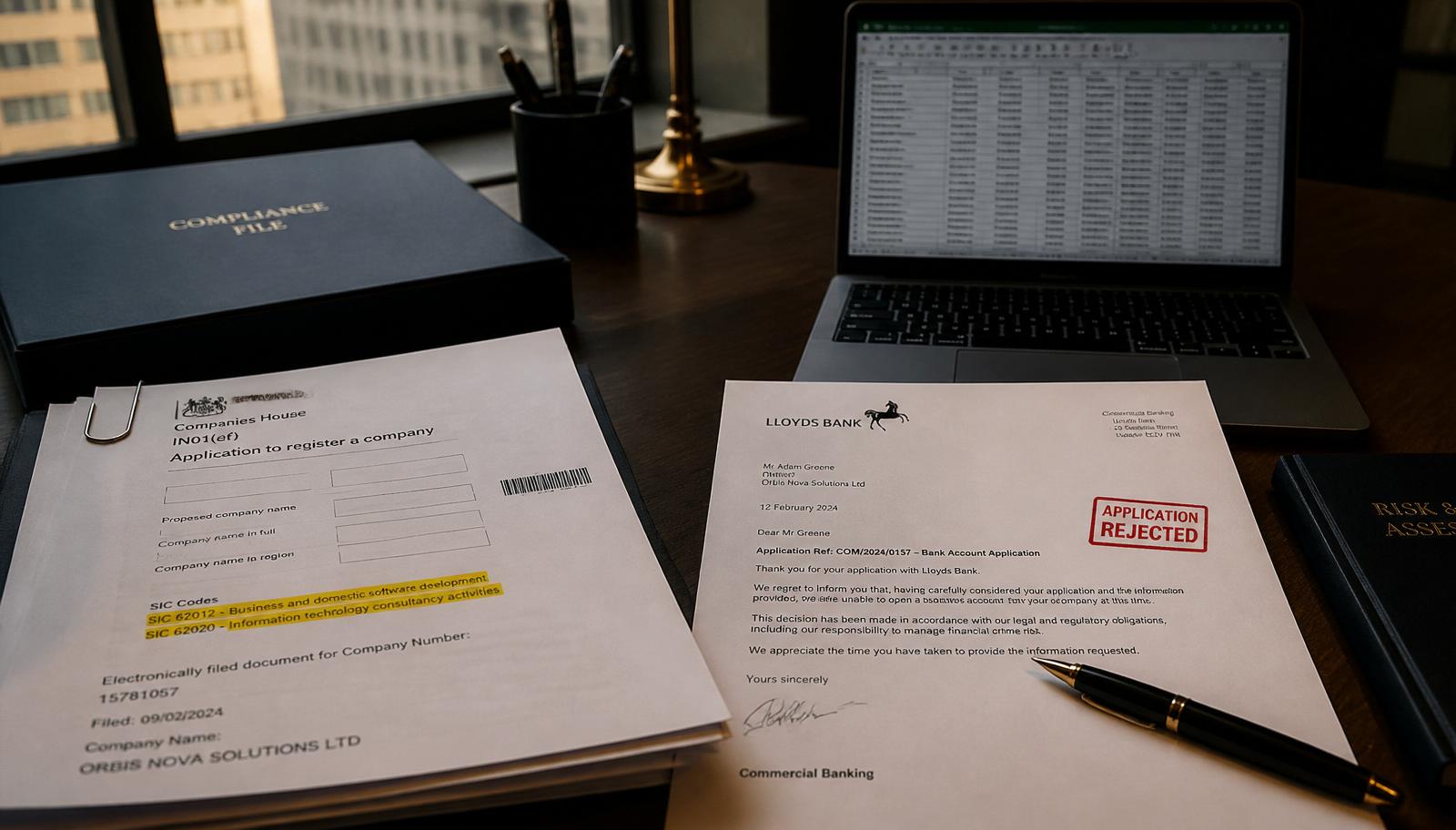
The decline letter every non-resident founder eventually reads is deliberately vague. Under the Proceeds of Crime Act 2002 and the FCA's own guidance on financial-crime risk, UK banks are not obliged to disclose the reasoning behind an account refusal and, in most cases, actively will not. The letter therefore tells you what happened ("we are unable to open an account") without telling you why. It is not evidence that being a non-resident was the problem. It is evidence that the underwriter could not, on the file in front of them, justify an approval.
What actually happens inside the review is more mundane. A non-resident file arrives with fewer corroborating signals than a UK-domiciled one — no UK utility bill, no UK employer, no UK payroll history, no HMRC self-assessment record — so the underwriter must reconstruct trust from the documents supplied. When those documents corroborate each other, the file is approved. When one of them contradicts the others, the whole file collapses to the weakest signal, and the summary reason on the letter becomes the residency of the director because that is the shortest true statement the bank can make without disclosing internal reasoning.
What UK underwriting actually looks at
A UK business account application is scored on five overlapping questions. First, is the entity real and well-formed — does Companies House show a live company with a clean filing history, a coherent officer list, and a PSC register that reconciles with the shareholding? Second, is every individual on the file identifiable — do the passport, the residential address proof and the tax residence declaration point to the same person at the same address? Third, is the activity plausible — does the SIC code match the business summary, does the summary match the invoices, and are the customer geography and average ticket coherent with the deposit profile the applicant expects? Fourth, is the source of funds explained — where did the seed capital come from, who paid it, and can it be evidenced? Fifth, does the file survive automated screening — sanctions, PEP, adverse media and fraud-prevention databases including CIFAS.
A file that passes all five is approved regardless of the director's residency. A file that fails any one of them is declined regardless of how good the other four look. That is the entire architecture — and it is why the fixes below are so specific.
The 14 real rejection triggers
These are the recurring patterns we see when we review declined non-resident files. Not every trigger appears on every decline; two or three together are usually enough.
The director's residential address on the passport, on the utility bill and on the Companies House record must be the same address, written the same way. A single mismatched line breaks automated ID verification and demotes the file to a manual queue where the weakest remaining signal usually decides.
82990, 70229, 74909 and 96090 are recognised by every UK underwriting model as 'unclassified' fallbacks. They are legal, but they force the underwriter to guess what the company does and — in a non-resident file — that guess rarely lands well.
The single free-text field on the application is read by a human. 'International consulting to global clients' fails; 'B2B SaaS analytics for European mid-market e-commerce brands, invoiced monthly in GBP and EUR, average ticket £600/month' passes.
If the shareholder register shows 100% held by an overseas entity and the PSC register shows only the individual director, the file is inconsistent on its face. Underwriters cannot approve inconsistent files even when the underlying reality is benign.
A registered office in a residential apartment overseas — or worse, at a serviced-mail address in a jurisdiction the bank considers higher-risk — is a well-known soft-decline trigger. A professional London registered office is the standard fix.
When every address on the file is the same virtual address, the underwriter cannot separate the company from the mail forwarder. Separating the director's service address from the registered office resolves this.
'Personal savings' is not a narrative. 'Personal savings accumulated over eight years as an employed software engineer at [named employer], evidenced by three years of payslips and a bank statement showing the transfer to the company account' is a narrative — and it passes.
Not a public list, not a disqualification — but a threshold above which corroborating evidence must be stronger. Founders who supply that evidence proactively rarely see 'country' cited as the reason.
The screening tool does not distinguish between the applicant and a namesake with a public regulatory record. A short covering note that pre-empts the false positive, with dates of birth and countries, removes the flag.
A director, shareholder or PSC who is a Politically Exposed Person, or whose immediate family member is, will trigger enhanced due diligence. The file is not automatically refused — but silence about the connection almost always is.
These activities require regulated permissions the founder frequently has not obtained. Every UK bank and EMI has a published exclusion list; applying to a provider whose list includes your activity is a certain decline.
Applying to five providers in a week is itself a risk signal picked up by fraud-prevention models. A staggered sequence with a corrected file between applications performs materially better.
A UK Limited Company owned by a BVI company owned by a Seychelles trust is legal, but the underwriter must document why the structure exists. When the rationale is 'the accountant recommended it', the file is refused. When the rationale is a specific commercial or estate-planning need, evidenced by a lawyer's letter, it is not.
From the 2024–2026 reforms, directors and PSCs must complete Companies House identity verification. A file where this is outstanding tells the underwriter the company is not yet in good standing with its own registrar — a preventable and expensive signal to send.
How to read a decline letter (and what it doesn't say)
A UK decline letter is a compliance artefact, not a communication. Three phrases carry almost all of the meaning it is legally allowed to convey. "We are unable to open an account at this time" is the neutral form and usually means the automated model refused before human review; the underlying trigger is almost always documentary. "We have carefully considered your application" indicates a human reviewed the file and could not reconcile it; the trigger is usually structural — PSC, SIC, source of funds. "In line with our internal risk appetite" is the phrase used when the activity itself is on an exclusion list, or when a sanctions/adverse-media hit was not resolved; re-applying to the same provider without changing the underlying position is futile.
What the letter never says, and what founders should stop looking for, is a specific instruction to fix. The bank is not permitted to coach applicants through anti-money-laundering thresholds. Your advisor is.
The rebuild playbook: fix, then re-apply
A file that has been refused should not be re-submitted; it should be rebuilt. The sequence we run for clients moves in the same order every time because underwriting reads the file in the same order every time.
- Reconcile Companies House. Compare the shareholder register, the PSC register, the officer addresses, the registered office and the SIC codes. Anything that contradicts anything else is fixed by filing before the next application, not during it.
- Complete director identity verification. The 2024–2026 Companies House reforms make this mandatory; leaving it outstanding tells every underwriter the company is not yet in good standing with its own registrar.
- Rewrite the business summary. Two hundred words, naming the specific service or product, the customer segment, the countries funds will flow to and from, the expected monthly turnover, the average ticket size and the sales channel. Read it back; if a stranger cannot tell what the company does, rewrite it.
- Match the SIC code to the summary. If the summary describes B2B software, the SIC is 62012 or 62020, not 82990. If it describes cross-border e-commerce, the SIC is 47910, not 74909. Filing a SIC change costs nothing and takes 24 hours; it is one of the highest-leverage fixes in the whole rebuild.
- Assemble a source-of-funds pack. Bank statements evidencing the seed capital, employer or client references dated, and a covering note in plain English that ties the numbers together.
- Separate addresses. Registered office at a professional London address; director's service address at a different professional address; residential address matching the passport and utility bill exactly.
- Pre-empt screening hits. If a namesake exists in adverse media or on a sanctions list, disclose it up front with dates of birth and countries. The screen will hit; you decide whether the underwriter reads your covering note first or the tool's flag first.
- Sequence the re-application. One provider at a time, in an order that starts with EMIs whose exclusion list does not touch your activity, and moves to high-street banks only after 6–12 months of trading history exists.
The business summary that flips borderline files
The single free-text field on every UK business account application does more work than any other part of the file. It is read by a human, it is copied into the customer-due-diligence record verbatim, and it is what the underwriter defends internally when the file is close. A summary that reads "We are a consulting company providing services to international clients" defends nothing. A summary that reads "The company provides technical due-diligence reports on early-stage SaaS businesses to European venture funds. Six named clients so far, average engagement £8,000 invoiced in GBP, expected monthly turnover £15,000–£30,000, funds received by bank transfer from client entities in France, Germany and the Netherlands" defends itself.
Notice what the passing version does: it names the deliverable, the customer type, the geography, the ticket size, the channel and the expected volume. Notice what it does not do: use marketing language, promise growth, or describe the market opportunity. The underwriter is not evaluating whether the business will succeed; they are evaluating whether the account will do what the applicant says it will do.
Country tiers, sanctions and adverse media
Every UK bank and EMI maintains an internal geography model that is not published and does not correspond exactly to any public list. What it does correspond to is the FATF grey/black-list, the UK, EU and US sanctions regimes, and each provider's own historical loss data. Founders from countries in the higher tiers of these models are not refused for being from those countries — they are asked, implicitly, to supply stronger corroborating evidence. Supplying it proactively is the difference between an approval and a decline.
Adverse-media screening is the other quiet failure mode. The tools banks use — World-Check, LexisNexis, Dow Jones — cannot always distinguish between a common name and a namesake with a public regulatory record. A short covering note listing full legal name, date of birth, country of birth and current residence pre-empts the false positive and, in our experience, removes it from the file before it reaches the underwriter's desk.
The right re-application sequence
After a decline, the temptation is to apply everywhere at once. It is the worst possible move. Fraud-prevention models detect rapid sequential applications with the same details and treat the pattern itself as a risk signal, which means the second and third applications are declined faster than the first — not because the file got worse but because the pattern got noisier.
The productive sequence is one provider at a time, at least two weeks apart, in an order matched to the activity. For most non-resident founders in 2026 that means Wise Business or Airwallex first (broad geography, digital onboarding, fast decision), Revolut Business second (stronger for European customer bases), Payoneer third (strongest for marketplace and e-commerce sellers with a settlement history), and high-street banks — HSBC Kinetic, Barclays, Lloyds — only after 6–12 months of clean trading has produced statements the bank can read. Applying to a high-street bank as a non-resident on day one of trading, with no UK counterparties and no filed accounts, is a route to a decline that then contaminates the file for the next year.
What not to do after a decline
- Order Companies House identity verification before the bank application, not after
- Match the SIC code to the business summary and the invoices
- Separate director's service address from registered office address
- Draft a business summary that names customers, geography, ticket size and channel
- Provide a source-of-funds narrative with dates, employers and evidence
- Disclose PEP or sanctions proximity proactively and in writing
- Space applications: one at a time, with fixes between
- Keep the shareholder register and PSC register mathematically consistent
- Re-submit the same file the day after a decline
- Apply to a provider whose exclusion list includes your activity
- Use a residential address abroad as the registered office
- Describe the business as 'consulting' or 'IT services' without qualifiers
- Layer overseas holding entities without a written commercial rationale
- Assume the bank will explain why the file was declined
- Treat the Companies House identity verification as optional
- Hide a PEP or adverse-media connection and hope the screen misses it
Our Business Banking Assistance is a structured review of the exact fourteen triggers on this page — Companies House record, SIC code, PSC reconciliation, address consistency, source-of-funds narrative, business summary, screening pre-empts and re-application sequencing. We do not guarantee approval; we remove the fixable reasons for refusal.
Frequently asked questions
Why do UK banks reject non-resident founders even when the company is fully compliant?+
Compliance at Companies House and bank underwriting are two separate tests. A company can be perfectly filed and still fail the bank's risk model because underwriting weighs a different set of signals — director residency, the coherence of the business narrative, the SIC code choice, the source-of-funds story, the customer geography and the sanctions/PEP screen — none of which Companies House verifies.
Is 'non-resident' itself the reason?+
Rarely on its own. There is no UK banking rule that forbids non-resident directors. What actually happens is that a non-resident file arrives with weaker corroborating evidence — no UK utility bill, no UK counterparties, no UK employer reference — and the underwriter has to reconstruct trust from documents alone. When the documents are internally inconsistent, the file is declined and 'non-resident' becomes the summary reason on the letter, not the underlying cause.
Can a decline be appealed?+
Almost never with the same provider on the same file. UK banks and EMIs are not obliged to give a reason under the Proceeds of Crime Act 2002 and rarely disclose one in writing. The productive route is not appeal but re-application: identify the specific trigger, fix it in the underlying company record, and apply to a different provider first while the original file ages out of the internal review queue (typically 6–12 months).
Will a UK registered office change the outcome?+
It removes one friction point, not all of them. A professional London registered office and director's service address tells the underwriter the correspondence trail is stable and that the company is not run from a serviced-mail box in a jurisdiction the bank does not like. It does not create business substance, and no reputable provider should suggest that it does.
Does using an EMI (Wise, Revolut Business, Airwallex, Payoneer) instead of a bank avoid the problem?+
It moves the goalposts, not the game. EMIs run the same core checks — identity, PSC, sanctions, source of funds, business rationale — but tolerate more geographies and onboard faster because they do not extend credit. A file that is declined by a high-street bank for lack of UK footprint is often approved by an EMI on the strength of the same Companies House record; a file that is declined for sanctions, adverse media or an incoherent activity description will be declined everywhere.
How much does the SIC code really matter?+
A great deal, disproportionately to how casually it is chosen at incorporation. The SIC code is the first field the underwriter's automated model reads. A vague code like 82990 ('Other business support service activities'), 70229 ('Other management consultancy') or 74909 ('Other professional, scientific and technical activities') is a well-known soft-decline trigger for non-resident applicants because it forces the underwriter to guess. A precise code that matches the business summary and the invoice trail is one of the cheapest, highest-leverage fixes in the whole application.
Do banks share rejection data with each other?+
Not directly, but the ecosystem produces the same effect. CIFAS (the UK fraud prevention service) records confirmed fraud markers that most banks and EMIs consult, and every provider maintains its own internal record of prior declines. There is no shared 'blacklist' of ordinary declines, but a pattern of rapid sequential applications with the same details across multiple providers is itself a risk signal.
Should I incorporate first and worry about banking later, or the other way round?+
Incorporate first — the company must exist before any bank or EMI will open an account for it — but design the incorporation with the banking review in mind. That means the right SIC code, a director's service address that is not a residential flat, a PSC declaration that reconciles with the shareholding, and a business summary drafted in language an underwriter recognises. Retrofitting these after a decline is far more expensive than getting them right the first time.
Is there a country list that automatically disqualifies me?+
There is no public list, and no country on its own is disqualifying. What exists internally are risk tiers based on FATF grey/black-list status, comprehensive sanctions, and each provider's own historical loss data. Founders from countries in the higher tiers are not refused; they are asked for more corroborating evidence — a stronger source-of-funds narrative, clearer customer geography, a matching tax residence document — which they can supply.
What is the single most common fixable reason for decline?+
Address mismatch. The director's residential address on the passport or national ID must reconcile with the residential address proof (utility, bank statement or government letter dated within three months) and with the address filed on the Companies House PSC/officer record. A mismatch of a single street number is enough to fail an automated ID verification and route the file to manual review, where the next weakest signal then decides the outcome.
Does a UK accountant on the file help?+
Yes, when the accountant is a real ongoing engagement rather than a name on a form. Bank underwriters weight ongoing professional relationships — accountant, registered office provider, corporate service advisor — as evidence of accountability. A named ACCA/ICAEW/CIMA accountant with a UK practising address, referenced in the business summary, measurably improves borderline files.
How long should I wait before re-applying after a decline?+
With the same provider, 6–12 months and only after the underlying trigger has been fixed and can be evidenced. With a different provider, immediately — but with a file that has been rebuilt, not re-submitted. Re-applying with the same information within days is the fastest way to convert one decline into a pattern.
Will opening a personal UK account first help my business application?+
In most current models, no. Personal and business underwriting run separately, and a personal account opened as a non-resident is itself hard to obtain in 2026. The higher-leverage move is getting the business file right the first time rather than layering account applications.
Do you guarantee approval if I use your Business Banking Assistance?+
No, and any provider or advisor who does should be treated with caution. Every UK bank and EMI reserves the sole discretion to accept, refuse or close an account. What we do is remove the fixable reasons — structure, documentation, SIC code, address, business narrative, source-of-funds evidence — so that the decision is made on the merits of the business rather than the state of the paperwork.
- Opening a UK business bank account as a non-resident founder →
- How to form a UK company as a non-resident: the complete 2026 guide →
- SIC codes: choosing the right industry code at Companies House →
- PSC declarations explained: who counts as a Person with Significant Control →
- Companies House Identity Verification service →
Editorial note: UK Company Experts is a trading name of Seven Oak Prestige Ltd. We are an advisory firm and not affiliated with any UK bank, EMI or payment provider named on this page. No provider guarantees approval; every account decision is at the provider's sole discretion. This article is general information, not legal, tax or financial advice.
Related guides from our editorial library.
Browse all insights